
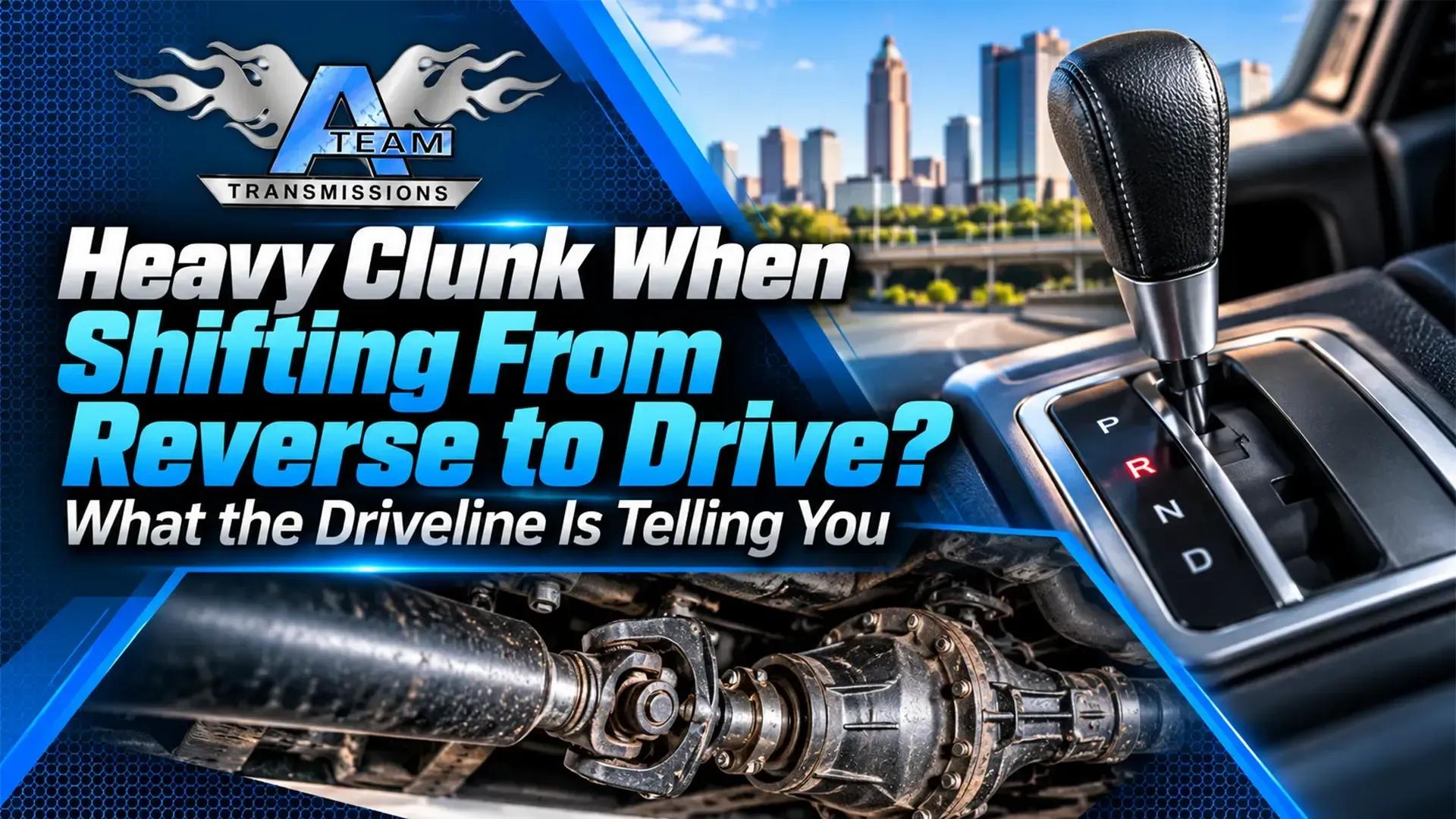
A clunk when shifting from Reverse to Drive often means free play is being taken up in the driveline. It may occur once during a parking maneuver.
A Team Transmissions helps locate the source of that movement. Our
driveshaft and U-joint repair process checks connected parts before we recommend any work.
Load Reversal Exposes Driveline Slack
Healthy parts have controlled clearance without a harsh impact. Wear in several components can combine into one clunk, especially on an incline or with immediate throttle.
The Transmission Is Not the Only Possibility
A reverse-to-drive clunk does not prove internal transmission failure. U-joints, splines, axle joints, differential gears, and mounts can move when torque changes direction. Diagnosis should locate it first.
Common Sources of a Heavy Driveline Clunk
Common sources include worn U-joints, loose splines, differential backlash, axle play, and damaged mounts. The exact combination varies by drivetrain layout.
Worn U-Joints or Driveshaft Parts
A worn U-joint can clunk when the driveshaft changes direction. Dry caps, damaged seals, or worn splines add movement. Some vehicles need U-joint replacement, while others need another shaft repair.
Differential Backlash or Mount Wear
Differential gears need controlled clearance. Excess backlash, worn bearings, or a loose mount can knock as the load reverses. Our differential repair in Columbus, OH, checks noise patterns, fluid, leaks, and related movement.
Axle, CV Joint, or Spline Play
Axle splines and CV joints can also develop clearance. Clicking during turns or vibration under acceleration helps separate axle wear from driveshaft or differential trouble.
Engine or Transmission Mount Movement
A damaged mount may let the powertrain move too far in Reverse or Drive. The thump can feel internal, so nearby joints and shafts also need checking.
Driving Habits Can Make the Clunk More Noticeable
Changing direction before stopping sends a sharp load through the driveline. Our guide to shifting from Reverse to Drive before stopping explains why the brakes should stop the vehicle first. A full stop reduces shock but cannot remove play.
The clunk may seem stronger on a slope or with a trailer. Added load makes clearance easier to hear but does not identify one failed part.
How Columbus Roads and Weather Affect the Driveline
Potholes, salt, and freeze-thaw cycles expose weak joints, seals, and mounts. Franklin County work trucks and I-270 commuters also face repeated stops. Clunks may stand out on Hamilton Road or East Broad Street.
Before winter travel, review Ohio Department of Transportation road-condition information for traffic and weather updates. Avoiding impacts helps, but an existing clunk still needs inspection.
How We Perform a Driveline Clunk Diagnosis
A driveline clunk diagnosis starts with the conditions that produce the sound. At A Team Transmissions, we ask whether it happens once or repeatedly, on level ground or a slope, and with or without throttle.
On the lift, we check U-joints, splines, yokes, axles, CV joints, differential movement, mounts, and leaks. The location of play separates normal clearance from repair needs.
Matching the Repair to the Worn Part
The repair should address the part creating excess movement. It may involve U-joint replacement, driveshaft repair in Columbus, OH, a mount, axle part, or differential work. Transmission testing follows only when evidence points there.
Vehicle design shapes the inspection. Our Chevrolet transmission and related driveline service covers the Silverado, Equinox, and Tahoe. We match the repair to the vehicle.
Takeaways
A heavy reverse-to-drive clunk often points to excess movement as the load changes direction. U-joints, splines, axles, mounts, differential gears, and transmission parts are possible sources.
Stop fully before changing direction and note whether slopes, towing, or cold weather change the symptom. A complete inspection can identify the worn part.
Frequently Asked Questions
Why does my vehicle clunk when I shift from Reverse to Drive?
Your vehicle may clunk because worn driveline parts move as torque changes direction. U-joints, splines, axles, mounts, the differential, or the transmission may contribute, so inspection is needed.
Can a bad U-joint cause a clunk when changing direction?
Yes, a worn U-joint can clunk when the driveshaft reverses direction. Joint play may also cause vibration, squeaking, or a knock from a stop.
Does a reverse-to-drive clunk mean the transmission is failing?
No, a reverse-to-drive clunk does not automatically mean transmission failure. External driveline parts can create the same sound, so testing should locate the movement first.
Can I keep driving with a driveline clunk?
Limited driving may be possible, but a worsening clunk needs inspection. Stop driving if the vehicle vibrates heavily, loses power to the wheels, leaks fluid, or feels unsafe.
How is a reverse-to-drive clunk diagnosed?
A reverse-to-drive clunk is diagnosed with a symptom review, shift test, road test, and lift inspection. The technician checks joints, shafts, axles, mounts, differential parts, and the transmission.
Schedule a Driveline Inspection in Columbus
If your vehicle clunks during direction changes, contact our team to arrange an inspection. We will reproduce the symptom and explain the findings.
For North Columbus, call
(614) 848-8484 or visit
6200-C Huntley Road, Columbus, OH 43229. For East Columbus, call
(614) 864-9520 or visit
836 Refugee Rd, Pickerington, OH 43147. Use the location nearest your route.
Why a Clunk When Shifting From Reverse to Drive Happens
A single clunk can happen when torque reverses through worn driveline parts. Reverse loads gears, shafts, and joints one way. Drive loads them the other way, closing the excess clearance.
Share Us On:

Founder of
A Team Transmissions, Sean Avner, is a second-generation transmission specialist whose path began in the trade with his father, who owned an AAMCO in Decatur, GA. Before focusing on transmissions, Sean worked as a general technician at a small shop, giving him a practical view of how clear answers and honest service matter to drivers.
Since founding A Team Transmissions in March 2008, Sean has built the shop around integrity and long-term customer relationships, now serving central Ohio from locations in Columbus and Pickerington. As an ASE-certified shop, his team covers the full range of transmission and drivetrain service, from transmission diagnostics to clutch repair and replacement, with specialized experience servicing BMW and Ford transmissions including other makes and models.


